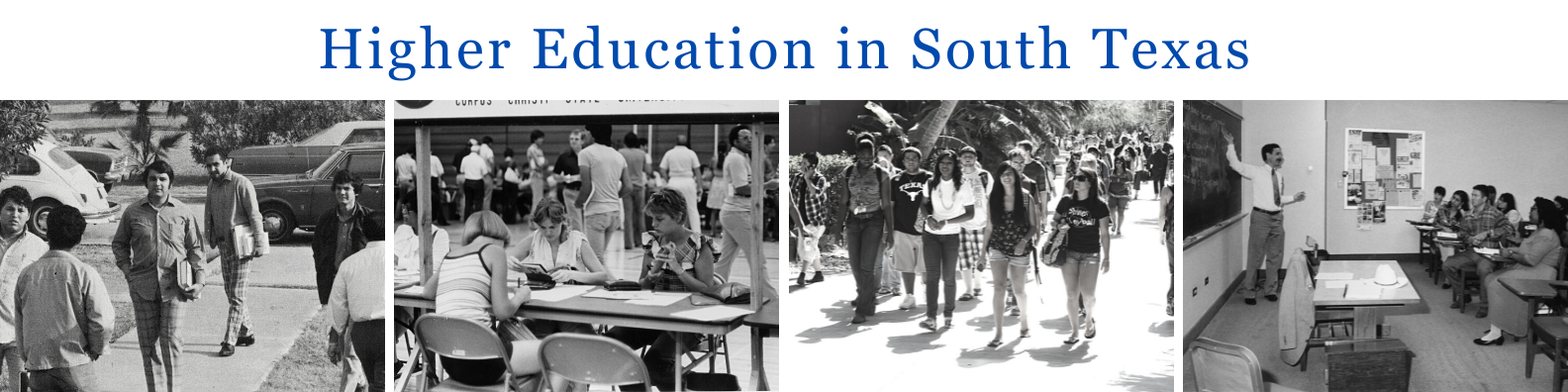
Seventeen Years of Service: Remembering the Texas A&M University-Corpus Christi Women’s Center for Education and Service (1995-2012)
By Rebecca K. Williamson
Evolution of Women in Higher Education
In 1837, Oberlin College [Oberlin, Ohio], admitted women as students, becoming the first college in the United States to do so. During the Civil War, more colleges admitted women, due to the shortage of male students. (Graham, 1978). During this time, the position of Dean of Women was created, then the highest faculty position for a woman. In 1870, women made up 21 percent of the total undergraduate population; by 1919, it was 47%. Many colleges and universities required women to have higher grades and test score than men, which led to fewer women being admitted to PhD programs and thus becoming professors. Many institutions only hired women as part-time lecturers, which also meant they never received any full-time benefits. Sex-based discrimination against women in higher ed led to the passage of the Title IX Amendment of the Civil Rights Act in 1972. From 1968 to 2008, the number of women who earned degrees tripled, and female college faculty doubled from 1970 to 2006 (Miller, 2020).
Gender inequality typically refers to differential access and unequal participation in higher education. While women now have equal access to higher education, they still experience discrimination, such as pay inequality, exclusion, and hostility from male students or coworkers. However, the development of supportive relationships with other women and forming interpersonal connections on campus can help improve women’s experiences and fight institutional sexism. Forming women's groups can give women an opportunity to share emotions, discuss issues, and organize to fight gender inequality (Vaccaro, 2011).
In 1995, Texas A&M University-Corpus Christi established the Women’s Center for Education and Service to extend education and services to assist in university efforts to create a diverse, inclusive, and sensitive campus environment. The Women’s Center for Education and Service was open for 17 years, closing in 2012 due to funding issues for full-time staff salaries.
Overview of the Women's Center for Education and Service
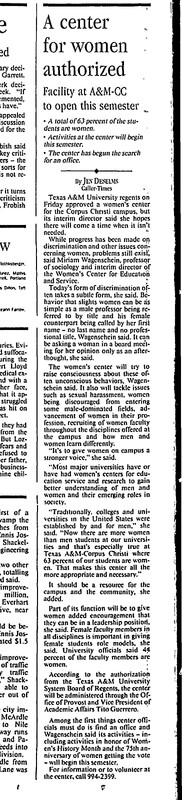
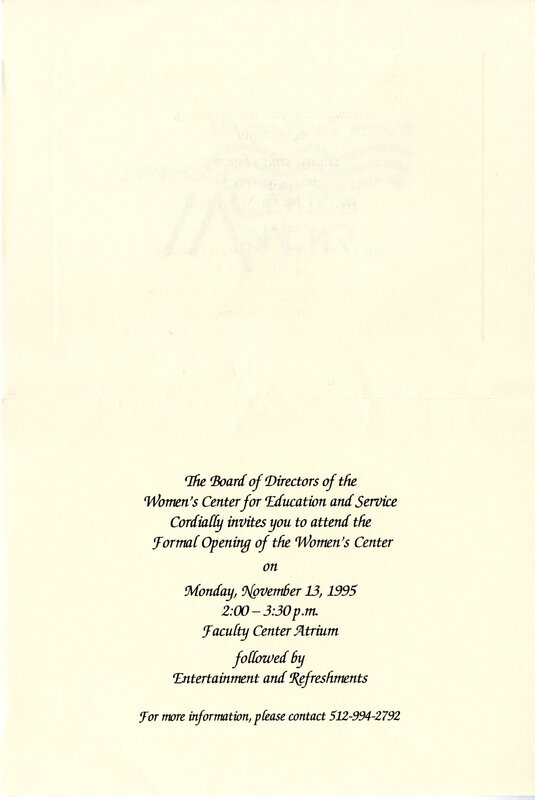
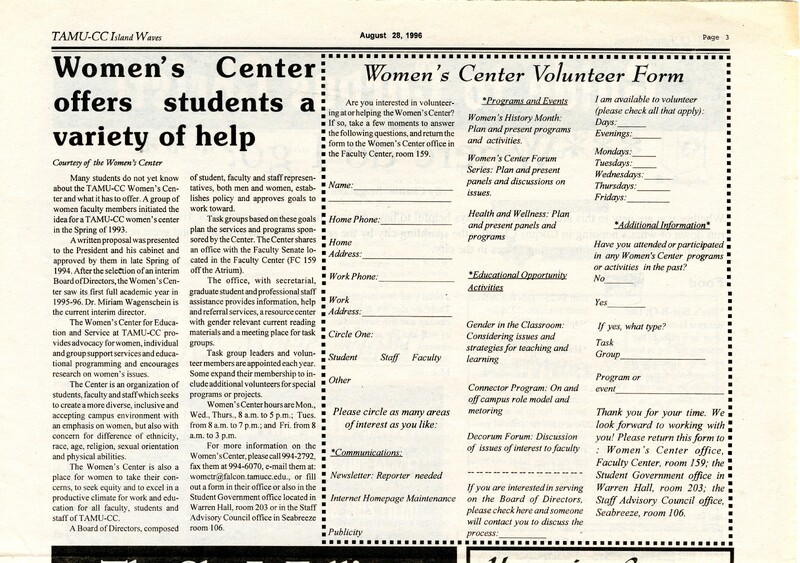
In January 1995, the Texas A&M System Board of Regents approved the proposal from Texas A&M University-Corpus Christi (TAMU-CC) to open the Women’s Center for Education and Service (Women’s Center). At that time, 63% of TAMU-CC’s students were women. The Women’s Center was administered through the office of the Provost and Vice President for Academic Affairs. Dr. Miriam Wagenschein, professor of Sociology, was named its interim director, and a board of directors was established, with the formal grand opening event held in November 1995.
The mission statement for the Women’s Center was “The Women’s Center for Education and Service supports the mission of Texas A&M University-Corpus Christi by promoting a supportive, equitable, and safe environment that advances and affirms the inherent dignity and worth of women through education, advocacy, and service endeavors.”
The Women’s Center’s daily operations were managed by a director (part-time faculty and part-time director appointments) and a secretary, with help from student workers. But decisions were made by the board of directors, made up of students, staff, faculty, and community representatives. Volunteers included students, faculty, staff, and community members, and they helped plan and manage events. The Women’s Center was located in Faculty Center and then in the University Center.
Administration of the Center eventually moved from the office of the Provost and Vice President for Academic Affairs to the Vice President of Student Affairs. In Spring 2012, a task force was convened to review the Center; while the Task Force recommended it remain open, the lack of adequate funding made staffing difficult and the decision was made to close the Center in April 2012.

Advocacy, Education, & Support Initiatives
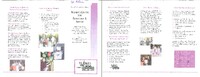
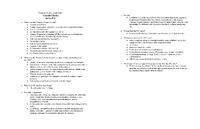
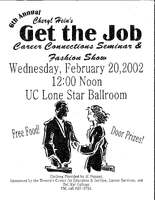
The Women’s Center offered support through various programs and events, both on campus and in the community. Examples include “Paint the Island Pink” in October for Breast Cancer Awareness, Celebration of Women in the Arts, sponsoring speakers such as Sheryl Swoopes of the WNBA, and working with the Women’s Shelter of South Texas. For Women’s History Month, in March, the Women’s Center arranged various forums to discuss topics such as women’s health and women employed in academia. The Women’s Center also included men in some of their forums, such as the “Get the Job: Career Connections and Fashion Show” which included the Dos and Don’ts of dressing for interviews. Many of these functions, such as the Vagina Monologues, were also fundraisers, to support their various events.
A major project the Women’s Center focused on was establishing a child-care facility on campus, that would be available to students, faculty, and staff. By 2001, partial funding, including a $10,000 grant from Citgo, had been secured and the Dean of the College of Education had agreed to provide space in the Early Childhood Development Center. Unfortunately, a one-time funding request for the remaining balance needed was not approved by the TAMU-CC President’s Cabinet and the project was ultimately discontinued.
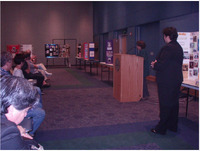
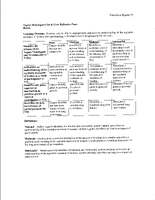
In support of education, the Women’s Center partnered with the TAMU-CC History Department and each spring, students in certain history classes presented posters and oral histories on various women in history, such as “Texas Women Speaking,” which also included a keynote speaker. Many of the events also included Assessment Measures and Learning Outcomes, such as Step Up! Bystander intervention quizzes, the Sexual Assault 1-minute mini-paper, and the Vagina Monologues cast and crew reflection paper. The Women’s Center also established The Islander Women in Leadership, a mentorship program which paired a faculty member with a student in her discipline. The student would identify challenges she faced, and the faculty member would work with the student to overcome them, as well as meeting to discuss program established topics such networking and communication. At the end of the year, students would submit a paper reflecting on their progress.
TAMU-CC College of Liberal Arts offered a Women’s Studies minor (currently called Women, Gender, and Sexuality Studies), but in 2010, there was a proposal for a Graduate Certificate in Women’s Studies. It included 18 credit hours of existing courses and one of the core courses would have required a graduate internship project through the Women’s Center. This proposal was not approved.
The Women’s Center published a newsletter to keep faculty, staff, and the community updated on their events. They maintained a website that included a calendar of events as well as photos from events and a Facebook page (found here).

Current Implications
Texas Senate Bill 17 (SB17) eliminated Diversity, Equity, and Inclusion (DEI) programs at public universities effective January 1, 2024. On January 20, 2025, President Donald Trump issued an executive order to terminate all DEI programs at institutions that receive federal funds. These two actions both claim DEI is illegal discrimination. States, such as Florida, are calling for gender studies programs to be shut down, stating this is an ideological movement rather than an academic discipline (Pettit, 2023). In 2022, the Wyoming legislature introduced a bill that would prohibit state funds from being used to fund gender studies programs and courses at the University of Wyoming. While it ultimately failed, it continues to highlight the idea that women’s studies is not academic, which continues to marginalize female students (Long and Ross, 2022). In June 2025, Texas Christian University closed its gender studies (and race and ethnic studies) departments and folded them into the English department, although university administration claims this is due to financial concerns and not the pressure from alumni and board members who have been calling for these programs to be cut completely (Whitford, 2025). Women are underrepresented in STEM, earning less than 1/3 of all degrees, and many higher education institutions have programs to attract female students, such as scholarships and summer camps. However, the Department of Education began investigating those programs for discrimination against men (Johnson, 2019).
The gender pay gap, especially in higher ed, remains. This chart created by The Chronicle of Higher Education staff in 2021 (found here), used Department of Education salary data from 2019-2020 for instructional staff at 4-year public institutions and shows that women earn less than men at every level. A report released in February 2021 on the highest-paid jobs at research universities, states that while women occupy 60% of professional jobs in higher ed, only 24% of women were top earners in the core employee group and only 12% at medical centers and 7% in athletics. Women of color were 2.2% in the core employee area (Williams June, 2021). Lawsuits have been filed on the basis of gender-based discrimination. In 2023, 5 female professors sued Vassar College with allegations of unequal pay and unfair promotion processes. In 2021, Syracuse University faced a similar lawsuit, as well as Princeton University and Northern Michigan University in 2020; all 3 of those lawsuits were found in favor of the plaintiffs with multi-million dollar payouts (Zahneis, 2023). In 2024, Pennsylvania State University settled with female faculty and staff, paying back wages with interest (Greenberg, 2024).
Unfortunately, although women on average hold more jobs than men at institutions of higher education and more women are enrolled than men, also earning a higher percentage of degrees, women still face discrimination in these areas and still have a need for the supportive relationships and interpersonal connections on campus.
Resources
Bernstein, E. (1996, October 10). Female world leaders focus of Monday luncheon. Corpus Christi Caller-Times. C1-2. https://infoweb.newsbank.com/apps/readex/doc?p=EANX&docref=image%2Fv2%3A1448A4D9F76DEB20%40EANX-17C3D3189BE1641B%402450367-17C3CD96C5F49920%4018&hlterms=%22women%27s%20center%20for%20education%22&origin=image%2Fv2%3A1448A4D9F76DEB20%40EANX-17C3D3189BE1641B%402450367-17C3CD96C5F49920%4018-17C3CD96C5F49920%40
Deselms, J. (1995, January 28). A center for women authorized: Facility at A&M-CC to open this semester. Corpus Christi Caller-Times. 18. https://infoweb.newsbank.com/apps/readex/doc?p=EANX&docref=image/v2%3A1448A4D9F76DEB20%40EANX-17C1FC4EF4A47045%402449746-17C0CCDD364DC49C%4017-17C0CCDD364DC49C%40&hlterms=%22women%27s%20center%20for%20education%22.
Formal opening invitation. TAMU-CC Women's Center. 005-013-026-000103. TAMU-CC Bell Library Archives. Corpus Christi, TX.
Graham, P. A. (1978). Expansion and Exclusion: A History of Women in American Higher Education. Signs, 3(4), 759–773. http://www.jstor.org/stable/3173112
Greenberg, S.H. (2024, September 19). Penn State to Pay $704K to Resolve Gender Pay Gap Allegations. Inside Higher Ed. https://www.insidehighered.com/news/quick-takes/2024/09/19/penn-state-pay-704k-settle-gender-pay-gap-allegations
Johnson, S. (2019, August 22). Women-Only STEM Programs Target the Gender Gap. Now the Education Dept. Is Investigating Them for Bias. The Chronicle of Higher Education. https://www.chronicle.com/article/women-only-stem-programs-target-the-gender-gap-now-the-education-dept-is-investigating-them-for-bias/
Learning Outcome for Vagina Monologues Cast & Crew Reflection Paper (in Transition Report by Randa Faseler Schell). TAMU-CC Women’s Center. RG37-001-001-0001. TAMU-CC Bell Library Archives. Corpus Christi, TX.
Long, C. and Ross, A. (2022, March 2). ‘Dangerous Ground’: Republican Lawmakers Target Gender Studies at U. of Wyoming. The Chronicle of Higher Education. https://www.chronicle.com/article/dangerous-ground-republican-lawmakers-target-gender-studies-at-u-of-wyoming
Pettit, E. (2023, August 10). New College of Florida’s Board Starts to Dismantle Gender-Studies Program. The Chronicle of Higher Education. https://www.chronicle.com/article/new-college-of-floridas-board-starts-to-dismantle-gender-studies-program
TAMU-CC History Department. (2011, February 9). Photo of the 2011 Poster & Oral History Presentation [image attached] [Photo upload]. Facebook. https://www.facebook.com/photo/?fbid=187343561297796&set=a.187343481297804
Texas A&M University Women's Center for Education and Service (n.d.) Texas A&M University-Corpus Christi Women's Center for Education & Service Brochure. Dr. Diana Ivy Personal Files.
Texas A&M University Women's Center for Education and Service (2002) Texas A&M University-Corpus Christi Women's Center for Education & Service flyer, "Get the Job" forum. Dr. Diana Ivy Personal Files.
Texas A&M University Women's Center for Education and Service (2002) Texas A&M University-Corpus Christi Women's Center for Education & Service Newsletter, 6(1). Dr. Diana Ivy Personal Files.
Texas A&M University Women's Center for Education and Service Task Force. (2012). Committee Results. [Report]. Ann DeGaish Personal Files.
The Chronicle of Higher Education. (2021, August 15). Average Salaries of Instructional Staff at 4-Year Public Institutions, 2019-20. The Chronicle of Higher Education. https://www.chronicle.com/article/average-salaries-of-instructional-staff-at-4-year-public-institutions-2019-20
Vaccaro, A. (2011). THE ROAD TO GENDER EQUALITY IN HIGHER EDUCATION: SEXISM, STANDPOINTS, AND SUCCESS. Wagadu: A Journal of Transnational Women's and Gender Studies, Suppl.Special Issue:Gender Equity in Higher Education, 9, 25-54. Retrieved from https://manowar.tamucc.edu/login?url=https://www.proquest.com/scholarly-journals/road-gender-equality-higher-education-sexism/docview/1015211576/se-2
Whitford, E. (2025, October 31). TCU Moves Race, Gender Studies Departments Amid Political Pressure. Inside Higher Ed. https://www.insidehighered.com/news/faculty-issues/curriculum/2025/10/31/tcu-moves-race-gender-studies-departments-english
Williams June, A. (2021, February 24). Who’s Mostly Missing From Among the Highest-Paid Employees at Top Research Institutions? Women. The Chronicle of Higher Education. https://www.chronicle.com/article/whos-mostly-missing-from-among-the-highest-paid-employees-at-top-research-institutions-women
Women in the oil industry flyer (in Transition Report by Randa Faseler Schell). TAMU-CC Women’s Center. RG37-001-001-0001. TAMU-CC Bell Library Archives. Corpus Christi, TX.
Women’s Center offers students a variety of help. (1996, August 28). TAMU-CC Island Waves. 3.
Zahneis, M. (2023, August 30). Vassar Professors Sue Over Gender Pay Gap, Claiming Discrimination Against Women on the Faculty. The Chronicle of Higher Education. https://www.chronicle.com/article/vassar-professors-sue-over-gender-pay-gap-claiming-discrimination-against-women-on-the-faculty